91 7065006006
 Student Login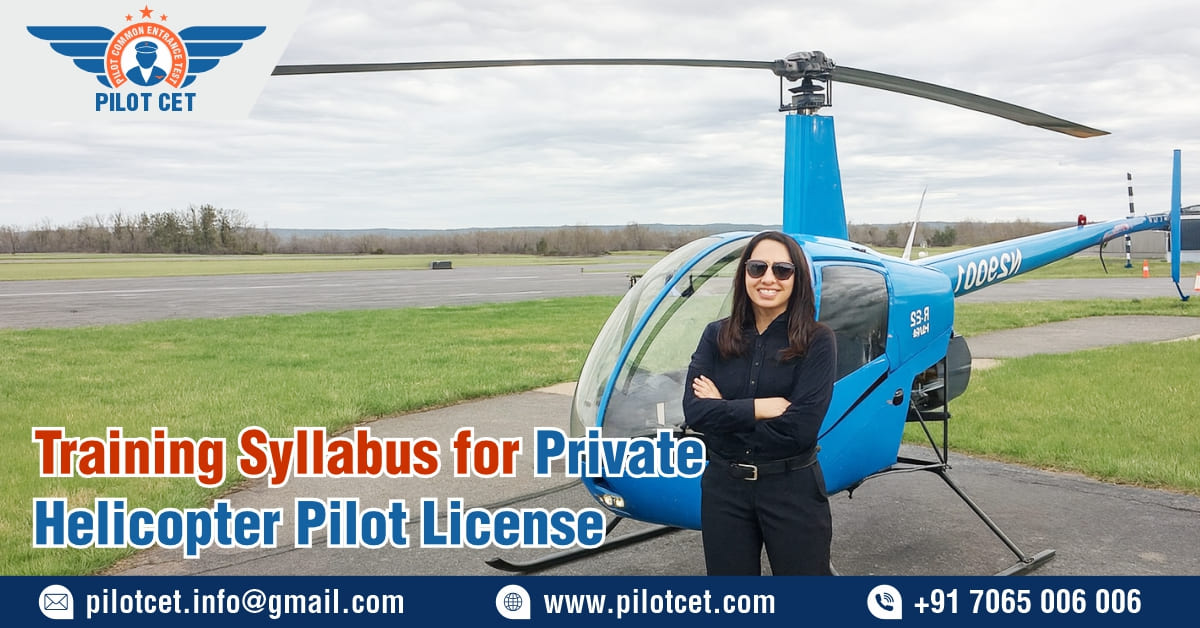
Training Syllabus for Private Helicopter Pilot License
Posted on : 5 December, 2025 12:09 pm
Private Helicopter Pilot License (PPL-H) is the basic license that allows you to fly a helicopter for personal use, hobby flying or private travel but you cannot use this license for paid or commercial flying work. During the training period of this course students gain essential knowledge of helicopter flying, safety, navigation and emergency handling so students can operate a helicopter confidently under Visual Flight Rules (VFR).
Who can apply?
Students have to meet these below given simple requirements to pursue PPL-H:
- Age: Minimum 17 years at the time of license issue.
- Education: Basic education 10th passed or 12th
- Medica l: Must clear Class 2 medical fitness.
- Interest: A strong passion for flying and willingness to learn practical and theoretical skills.
It is the first step for anyone who wants to enjoy flying or later upgrade to a Commercial Helicopter Pilot License.
Duration
| Component | Requirement |
|---|---|
| Total | 6 Months |
| Ground Training | 800 hours of ground classes |
| Flying Training | 40 hours of flying training |
Ground Training Modules
1. Air Navigation
Air navigation is all about how to find your way in the sky without GPS, maps or roads like we have on the ground.
What youll learn:
- Latitude, Longitude & Time: Learn how to use coordinates, how to calculate the local and universal time (need to know when to plan takeoffs and landings between time zones).
- Compass & Direction: Learn how to use radio based systems such as VOR, DME, NDB to keep on track on the runway during flight.
- Navigation Aids (NAVAIDs): How to use radio based systems like VOR, DME, NDB to stay on course during a flight.
- Dead Reckoning (DR): Estimating your position based on speed, direction and time when you dont have external references.
- Charts and Flight Planning: Using aeronautical charts, calculating distance, fuel requirements and alternate routes.
Why it is important: Navigation helps you to fly safely to your destination, prevent limited airspace and resolve the difficulties such as loss of GPS or emergency rerouting.
2. Air Regulations
Air regulations covers the legal and procedural framework every pilot must follow nationally and internationally.
What youll learn:
- DGCA & ICAO Rules: Indian aviation laws and international standards.
- Licensing & Certification: To obtain and renew PPL-H, medical fitness etc.
- Flight Rules: Visual Flight Rules (VFR), Instrument Flight Rules (IFR), rules of the air etc.
- Airspace Classification: Understanding different types of airspace and your responsibilities in each.
- Pilot Responsibilities: Learn as pilot in Command what are your legal duties and limits.
Why it is important: A mistake in following air regulations can lead to penalties, license cancellation or flight accidents.
3. Aviation Meteorology
Aviation meteorology is important in understanding the weather and atmospheric conditions that affect flight.
What youll learn:
- Atmosphere Composition: Layers of the atmosphere and their influence on aircraft performance.
- Cloud Formation & Weather Patterns: Types of clouds, fronts & pressure systems.
- Hazardous Weather: Thunderstorms, turbulence, wind shear, icing etc.
- Weather Forecasting Tools: METAR, TAF, SIGMET reports used to interpret real-time conditions.
- Visibility & Flight Planning: How weather impacts takeoff, cruising and landing.
Why it is important: Tackling weather conditions like visibility, safety, engine performance and flight schedules for smooth flight operations.
4. Technical General
Technical general gives you a complete understanding of aircraft design, components and functioning.
What youll learn:
• Helicopter Structure: Main rotor, tail rotor, fuselage, landing gear, and control surfaces. • Powerplant & Engines: Piston and turbine engines, fuel systems, lubrication, cooling, and engine limits. • Rotor Systems: Fully articulated, rigid, and semi-rigid rotor designs and their effects on handling. • Flight Instruments: Altimeter, airspeed indicator, vertical speed indicator, compass, and engine gauges. • Electrical & Hydraulic Systems: How power supply, circuits, and hydraulic components support operations. • Fuel & Oil Systems: Types of fuel, consumption, contamination checks, and safety practices. • Limitations & Performance: Weight, balance, center of gravity, hover ceilings, and performance charts. • Pre-flight Checks: Inspection procedures, system checks, and identifying potential hazards.
Why it is important: Technical failures are a major cause of in-flight emergencies. Understanding your aircraft helps you react smartly.
5. Technical Specific
Principles of Flight (Helicopter) is important to understand how helicopters generate lift, maneuver, and respond to controls in the air. What youll learn: • Helicopter Aerodynamics: How lift, drag, thrust and weight interact in helicopter flight. • Rotor Theory: Main rotor and tail rotor functions, rotor disc and induced airflow. • Stability & Control: Cyclic, collective, anti-torque pedals and their effects on flight. • Flight Maneuvers: Hovering, climbs, descents, turns, autorotation and confined area operations. • Performance Factors: Weight & balance, center of gravity, altitude, temperature and their impact on flight. • Emergency Handling: Autorotation, engine failure response and other critical flight scenarios.
Why it is important: Every aircraft behaves differently. Knowing your aircraft deeply means better control and safety.
Flying Training
After qualifying DGCA modules, students can start their flying training of 40 hours. Breakdown of PPL-H flying training i sgiven below:
| Flying Component | Min Hours | Details |
|---|---|---|
| Total Flying | 40 hours | Complete flight training requirement |
| Dual Flying (With Instructor) | 15 hours | Basic controls, hovering, navigation, emergency procedures |
| Solo Flying | 10 hours | Independent flying under supervision |
| Solo Cross-Country | 5 hours | Mandatory solo navigation flights |
| Additional Cross-Country / Dual | 10 hours | Remaining hours to meet total requirement |
- Basic maneuvers: Hovering, straight and level flight, climbs, descents and standard turns.
- Advanced maneuvers: Steep turns, confined area operations, quick-stops, and precision hover work.
- Navigation flights: Cross-country planning, map reading, checkpoints and VFR navigation.
- Emergency procedures: Engine failure, autorotation, tail rotor failure and forced landing practice.
- Solo flights: First solo, solo practice sessions and solo cross-country flights.
Exams & Skill Tests
- Written tests: Subject-wise DGCA exams covering regulations, navigation, meteorology, aircraft knowledge and principles of flight.
- RTR exam: Radio Telephony is not mandatory for PPL.
- Flight test: Final flying check with a DGCA-approved examiner to assess skills and safety procedures.
Training Helicopters Used for PPL-H
| Helicopter Model | Type | Common Use in Training |
|---|---|---|
| Robinson R22 | 2-seat light helicopter | Basic flight training, hovering practice |
| Robinson R44 | 4-seat light helicopter | Advanced training, cross-country flights |
| Bell 206 | Single-engine turbine | Professional-level training, turbine familiarization |
| Cabri G2 | 2-seat modern trainer | Safe, stable training platform for beginners |
The PPL-H syllabus gives students all the essential skills to fly a helicopter safely, starting from basic maneuvers to navigation, solo flights, and emergency handling. With solid ground knowledge and structured flight training, students build the confidence needed for independent flying.
For those who wish to take their aviation journey further, the next step after PPL-H is the Commercial Helicopter Pilot License (CHPL), which allows you to fly professionally and build a rewarding career in the helicopter industry.